

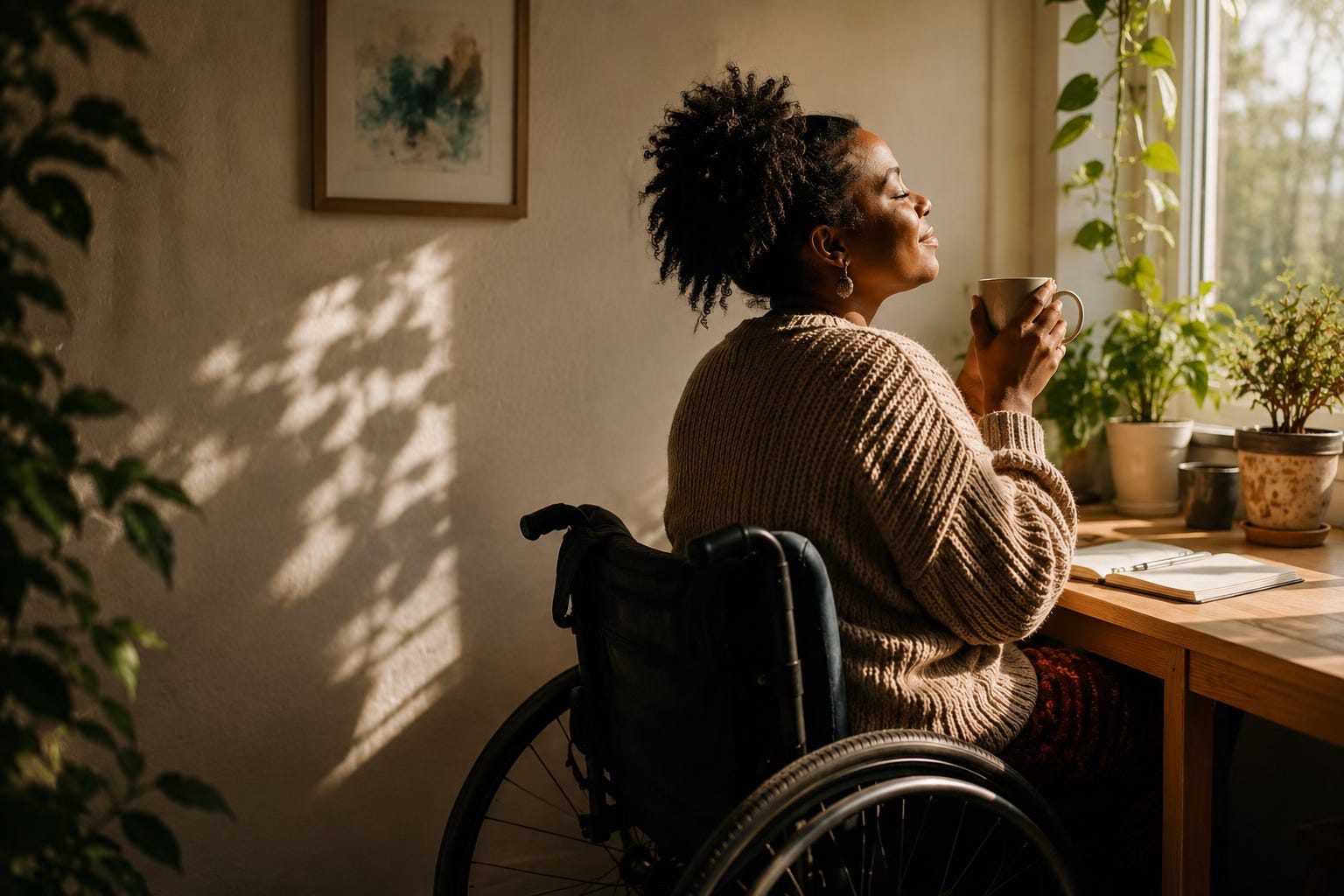
What if disabled people were allowed to be more than resilient?
It is exhausting to be known solely through limitation.
Appointments. Symptoms. Paperwork. Accommodation requests. Insurance denials. Medication changes. Functional capacity. Eligibility criteria. Productivity lost.
Over time, disabled life can become translated almost entirely into administration.
Even care is contingent upon assessment.
Can you work?
Can you lift?
How long can you stand?
How often do you need help?
What can’t you do?
The questions are often necessary. But repeated enough, they can narrow a person until their life becomes organized around deficits.
Not Who are you?
Not What delights you?
Not What are you building?
Not What makes you laugh until you forget pain for a moment?
Just: What is wrong, and how wrong is it?
I have been thinking lately about the phrase disabled joy, partly because it sounded unfamiliar to me at first.
Joy felt too large a word.
Too polished.
Too easily mistaken for optimism.
I think many people assume joy in disabled life must mean extraordinary triumph. Recovery stories. Inspiration. Perseverance despite impossible odds.
But perhaps disabled joy is softer than that.
Maybe disabled joy is a symptom flare easing enough to think clearly.
Enough energy to read.
To study for an exam.
To write something honest.
Maybe it is a doctor believing you without persuasion.
A body cooperating for one ordinary afternoon.
An accommodation approved without resistance.
Finding people who do not require explanations before offering care.
Maybe joy looks like realizing your worth was never supposed to depend on constant output.
Because much of what gets praised in modern life (discipline, productivity, consistency, endurance) assumes a body that’s predictable.
And many disabled people spend years learning how to survive systems designed around predictability.
There is grief in that.
Real grief.
Disabled joy does not erase grief any more than joy after loss means loss disappeared.
Both can exist.
A person can mourn what illness altered and still experience relief.
Anger and tenderness can coexist.
Exhaustion and delight.
Fear and hope.
The body can hurt while something inside remains capable of wonder.
Disabled joy is, in part, the refusal to surrender personhood.
The refusal to become only resilient.
Only inspiring.
Only compliant.
Only evidence of suffering.
Maybe disabled joy is saying:
I am still allowed softness.
I am still allowed pleasure.
I am still allowed ambition.
I am still allowed rest.
I am still allowed an ordinary life.
I am still allowed to become.
Not after recovery.
Not after improvement.
Now.
As I am.
Because disabled people have always created beauty, humor, art, intimacy, scholarship, families, movements, faith, and futures.
The world often documents disability through burden.
Disabled joy documents something else:
Presence.
Attachment.
Community.
Relief.
Meaning.
The quiet miracle of remaining fully human in systems that repeatedly ask you to prove it.
Perhaps that is what disabled joy means.
Not happiness without pain.
Not gratitude for suffering.
But the insistence that disabled life contains far more than survival.
And maybe that insistence is a form of freedom.
What has joy looked like for you during periods when your life or body felt constrained? I’ve been thinking about whether joy changes shape under limitation, rather than disappearing entirely.